Adult Ed x Community of Inquiry x System Dynamics
Explores digital learning in adult education as a dynamic system, using the Community of Inquiry framework to examine how presence emerges, adapts, and sometimes breaks under real-world conditions.
Field Note | July 1, 2026 · Jerry H. Yamashita · 2 min read
Most conversations about digital learning in adult education focus on access, tools, or modality.
Those things matter. But they don’t fully capture what actually happens in practice.
In adult education, digital learning is a system shaped by constraints—time, technology, competing responsibilities, and uneven participation. These aren’t edge cases, but everyday conditions the system operates within.
That’s where the Community of Inquiry (CoI) framework has more range than it’s typically given—if we shift how we think about it.
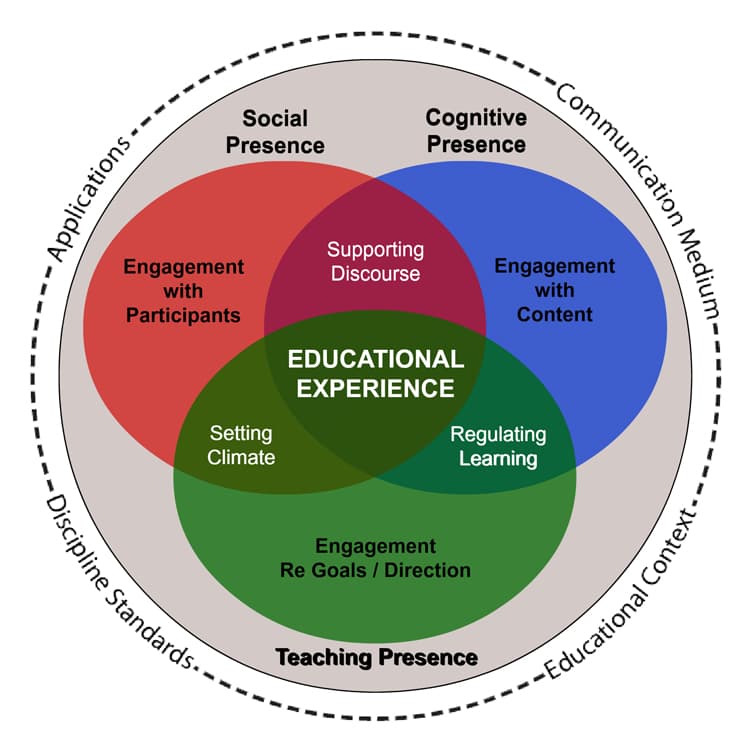
CoI is typically presented as three components: teaching presence, social presence, and cognitive presence (Garrison et al., 2000; Garrison, D. R., Anderson, T., & Archer, W. (2000). Critical inquiry in a text-based environment: Computer conferencing in higher education. The Internet and Higher Education, 2(2–3), 87–105. https://doi.org/10.1016/S1096-7516(00)00016-6View in referencesOpen source (opens in new tab)Garrison & Arbaugh, 2007)Garrison, D. R., & Arbaugh, J. B. (2007). Researching the community of inquiry framework: Review, issues, and future directions. The Internet and Higher Education, 10(3), 157–172. https://doi.org/10.1016/j.iheduc.2007.04.001View in referencesOpen source (opens in new tab). In theory, they’re distinct yet interconnected. In practice—especially in adult education—I'd argue they’re tightly interdependent.
They move together
When learners can’t attend synchronously—whether by design or by circumstance—teaching presence shifts in proportion to how well a course is structured and facilitated for asynchronous learning.
When participation is inconsistent, social presence describes how learners experience continuity through interruptions.
And cognitive presence—the actual process of meaning-making—emerges from how those other two hold up under pressure.
In other words, these presences exist in a course—and actively respond to conditions.
A systems view
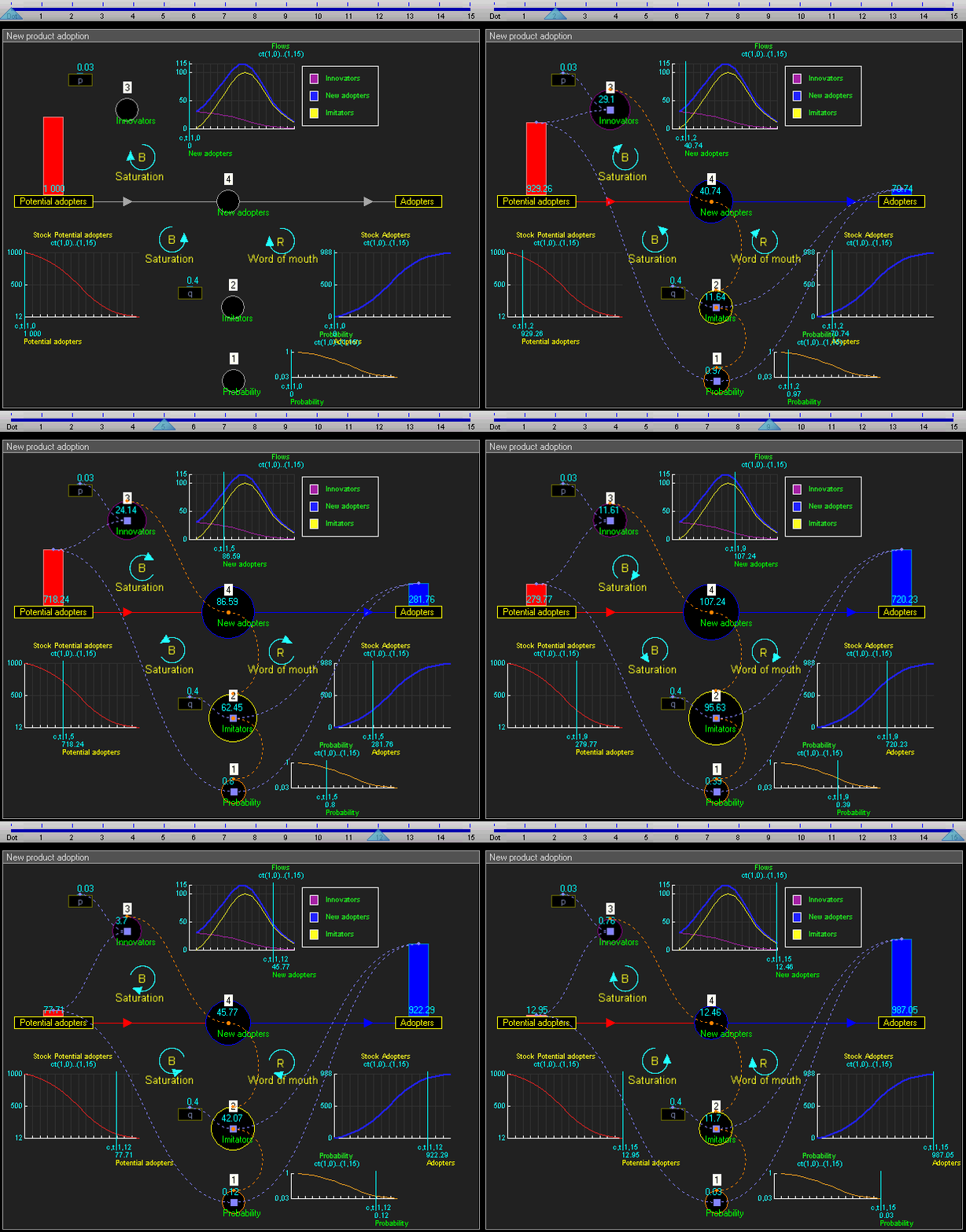
Whether it's understanding stock and flow (as illustrated in the animation above) or learners' engagement in your HyFlex citizenship class, from a system dynamics perspective, it's the same. What we’re really looking at is a set of interacting forces. Within the CoI framework, it might look like forces within each of the three domains:
- Teaching presence shapes structure, clarity, and expectations
- Social presence stabilizes participation and connection
- Cognitive presence emerges from the interaction of both
But none of these operate in isolation. They are constantly adjusting based on real-world constraints.
- Sometimes strong instructional design compensates for limited interaction.
- Sometimes peer connection sustains engagement when instruction is uneven.
- Sometimes everything degrades at once—not because the model failed, but because the system is under strain.
This is why digital learning in adult education can feel inconsistent, even unpredictable.
The model isn’t static—we’re working within a dynamic system.
And that’s also why adult education matters.
Because it operates under constraint, it reveals how learning systems actually behave—not under ideal conditions, but under real ones. It forces us to design for variability, not control. For resilience, not perfection.
A different question
If we start to see distance and digital learning through a systems lens, the question shifts.
| Not: | But: |
|---|---|
| Did we implement the model correctly? | How is the system functioning under the conditions learners actually experience? |
That’s a different kind of design problem.
In progress,-Jerry
Related reading
- The Limits to Growth (opens in new tab)
collections.dartmouth.edu
- The Learner Variability Navigator (opens in new tab)
lvp.digitalpromiseglobal.org
- Digital Resilience Among Individuals in School Education Settings: A Concept Analysis Based on a Scoping Review (opens in new tab)
pmc.ncbi.nlm.nih.gov
- An Introduction to The Community of Inquiry (opens in new tab)
thecommunityofinquiry.org
Comments
Sign in with GitHub to join the discussion. Each Lab post uses its own thread (linked by page URL).