Who Trains the Trainers? A Note on Adult Education's AI-Readiness Gap
There are plenty of frameworks for what learners should know about AI, and next to nothing for assessing whether the people teaching adult learners are ready to teach it. A short, exploratory look at that gap in adult education—and a few places a fix could start.
Field Note | July 24, 2026 · Jerry H. Yamashita · 9 min read
A familiar pattern
There are many thoughtful frameworks for what learners should know and be able to do with AI. A few of them are designed with adult learners or workers in mind. But is there anything in place to assess whether the people teaching adult learners are ready to teach them?
On the learner-facing side, the list adds up fast. ISTE's Profile of an AI-Ready Graduate (2026)International Society for Transforming Education. (2026). Profile of an AI-ready graduate. https://iste-ascd.org/aireadyView in referencesOpen source (opens in new tab) lays out six roles a student should grow into—Learner, Researcher, Synthesizer, Problem-Solver, Connector, Storyteller—with specific skills under each. The AILit framework maps AI literacy competencies for primary and secondary students internationally (European Commission & Organisation for Economic Co-operation and Development, 2026)European Commission, & Organisation for Economic Co-operation and Development. (2026). Empowering learners for the age of AI: An AI literacy framework for primary and secondary education. https://ailiteracyframework.org/View in referencesOpen source (opens in new tab). The U.S. Department of Labor (DOL) (2026)U.S. Department of Labor, Employment and Training Administration. (2026, February 13). Training and Employment Notice No. 07-25: The U.S. Department of Labor's Artificial Intelligence Literacy Framework. https://static1.squarespace.com/static/64398599b0c21f1705fb8fb3/t/698fa0eba80b0a4475f68eea/1771020523499/TEN+07-25+%28complete+document%29+%281%29.pdfView in referencesOpen source (opens in new tab) spells out what workers should be able to do in its AI Literacy Framework. At a state level, California's Department of Education describes AI literacy progressions for students (California Department of Education, 2025)California Department of Education. (2025). Guidance for the safe and effective use of artificial intelligence in California public schools. https://www.cde.ca.gov/ci/pl/aiincalifornia.aspView in referencesOpen source (opens in new tab).
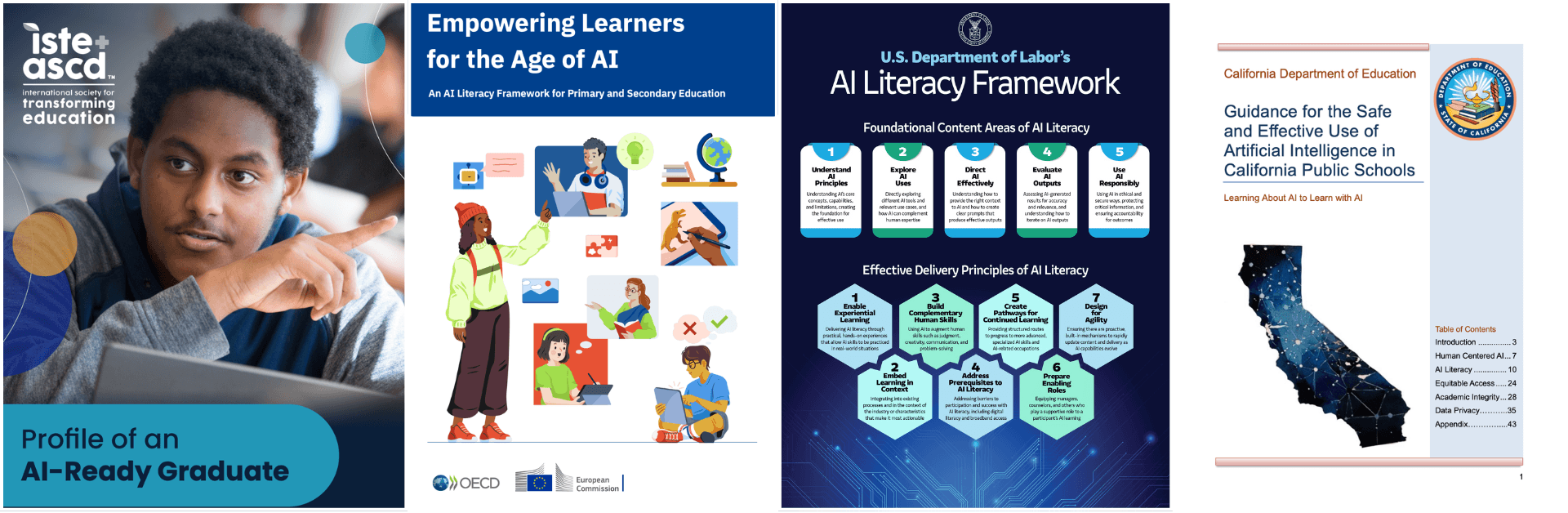
These are detailed, helpful documents, representing just four among many.
Now try to count the educator-facing side—specifically for adult education—and the list quickly runs short. Honestly, I believe there are no resources like that available right now—at least none that are well-known or widely recognized.
To clarify, picture a companion document to ISTE's profile—arguably one of the more adaptable K–12 frameworks, applicable to Adult Basic Education (ABE) or Adult Secondary Education (ASE) students, despite not originally being designed for adults. This document would specify what teachers need to understand and be able to do before they can guide learners into any of those six roles. That's the kind of resource I've been looking for, but I can't find one. It also raises an uncomfortable question before we even get to what students need: if those six roles are the bar for students, are we confident our teachers can clear it themselves, first?
The gap adult ed sees in itself
Interestingly, some recent guidance within adult education already highlights this gap. In California, for example, OTAN's Adult Education Digital Learning Guidance (DLG) points educators toward existing professional standards, including the federal LINCS Adult Education Teacher Competencies (American Institutes for Research, 2015)American Institutes for Research. (2015). Adult education teacher competencies. U.S. Department of Education, Office of Career, Technical, and Adult Education. https://lincs.ed.gov/federal-initiatives/teacher-effectiveness/competenciesView in referencesOpen source (opens in new tab) and the BRIDGES Digital Resilience Toolkit (World Education, 2025)World Education. (2025). BRIDGES: An open skills toolkit and framework for building digital resilience. https://digitalskillslibrary.org/bridges-interactive/View in referencesOpen source (opens in new tab), both of which it lists among its educator-facing standards (Outreach and Technical Assistance Network, 2025, p. 50)Outreach and Technical Assistance Network. (2025). California adult education digital learning guidance (Developed 2022, updated 2025). https://otan.us/Content/Documents/Resources/dlg/CAAdult-LearningGuide25REF.pdfView in referencesOpen source (opens in new tab). Both were built for adult educators. LINCS predates generative AI outright. BRIDGES is newer and already points to AI literacy in a few domains—a natural place for a future update to go deeper, if one isn't already underway. Neither treats it as a distinct area of competency. So, scaffolds for describing what an adult educator should know are already available, and they're actually doing their job really well. It’s just that AI has been evolving so quickly that it’s hard for any framework to keep up.
That pattern holds at the federal and global level too. The DOL's AI Literacy Framework acknowledges the need—its "Prepare Enabling Roles" principle notes that trainers and mentors require customized training (U.S. Department of Labor, 2026, p. I-10)U.S. Department of Labor, Employment and Training Administration. (2026, February 13). Training and Employment Notice No. 07-25: The U.S. Department of Labor's Artificial Intelligence Literacy Framework. https://static1.squarespace.com/static/64398599b0c21f1705fb8fb3/t/698fa0eba80b0a4475f68eea/1771020523499/TEN+07-25+%28complete+document%29+%281%29.pdfView in referencesOpen source (opens in new tab)—but that's an acknowledgment, not an articulation of competencies. The World Economic Forum's 2026 education-readiness framework does the same at a global scale: it lists "professional development" and "AI literacy frameworks" for educators as readiness signals a system should have, not as competencies any system has yet defined (World Economic Forum, 2026, pp. 32, 35)World Economic Forum. (2026, June 4). Shaping the future of learning: Education readiness for the age of AI [Insight report]. https://www.weforum.org/publications/shaping-the-future-of-learning-education-readiness-for-the-age-of-ai/View in referencesOpen source (opens in new tab). Different institutions, different scales, same shape: acknowledged as necessary, left unspecified.
Meanwhile, the K–12 community has been quite busy—UNESCO, Digital Promise, and American Institutes for Research have all published or are researching teacher-facing AI frameworks (Miao & Cukurova, 2024; Miao, F., & Cukurova, M. (2024). AI competency framework for teachers. UNESCO. https://unesdoc.unesco.org/ark:/48223/pf0000391104engView in referencesOpen source (opens in new tab)Mills et al., 2024; Mills, K., Ruiz, P., Lee, K., Coenraad, M., Fusco, J., Roschelle, J., & Weisgrau, J. (2024, May). AI literacy: A framework to understand, evaluate, and use emerging technology. Digital Promise. https://doi.org/10.51388/20.500.12265/218View in referencesOpen source (opens in new tab)American Institutes for Research, 2025)American Institutes for Research. (2025). Teaching with AI: Testing the promise and empowering educators [Project description]. https://www.air.org/project/teaching-ai-testing-promise-and-empowering-educatorsView in referencesOpen source (opens in new tab). Notably, California's Department of Education—the same guidance cited above for its student progressions—goes further than most: it builds a tiered (Basic/Intermediate/Advanced) training model for educators directly into its school guidance, with distinct learning objectives at each level (California Department of Education, 2025)California Department of Education. (2025). Guidance for the safe and effective use of artificial intelligence in California public schools. https://www.cde.ca.gov/ci/pl/aiincalifornia.aspView in referencesOpen source (opens in new tab). That's close to the shape of what I'm arguing adult ed needs. All good, well-resourced efforts. All scoped to K–12.
The impact on professional development
This skills gap doesn't stay theoretical for long. A 2025 survey of more than 600 educators in federally funded adult education programs found AI tool usage nearly evenly split—34% weekly or daily users, 31% occasional users, 35% never users—with fewer than 11% receiving PD across the full range of digital tools surveyed, including AI (Nguyen & Cacicio, 2025, pp. 8–9)Nguyen, D., & Cacicio, S. (2025, September). "I love what I do, but I don't stay for the pay": Perspectives from over 600 adult educators. ALL IN: The Adult Literacy and Learning Impact Network. https://allinliteracy.org/wp-content/uploads/2025/09/ALL-IN-Adult-Educator-Perspectives-Report-September-2025-FINAL.pdfView in referencesOpen source (opens in new tab). Without agreed competencies to design toward, PD has to organize around something else, and in practice that tends to be the tool itself—a session titled "Lesson Planning with ChatGPT," another "Getting Started with Midjourney," each pitched on how much time it saves or what the latest model can do. A 2025 study of GenAI professional development for Texas adult education teachers landed on a version of the same point from the delivery side: "prioritize teacher capacity building and clear institutional guidance for responsible use, with licenses and tools chosen to support those goals rather than the other way around" (Riggs et al., 2025, p. 14)Riggs, R., Vanek, J., & Goumas, J. (2025). From spark to practice: How adult education and literacy teachers perceive and use GenAI tools to create learning resources. World Education, a JSI initiative. https://publications.worlded.org/WEIInternet/inc/common/downloadpub.cfm?id=26700&lid=3View in referencesOpen source (opens in new tab). Without a clear understanding of what defines an AI-ready adult educator, it's impossible to determine whether each session effectively builds on the previous one or addresses educators' needs in the first place.
There's a layer underneath that, too. Maybe your district is a Microsoft or Google "shop," or maybe it's approved a standalone platform like ChatGPT for Teachers or Claude for Teachers. Either way, the PD available in your district, state, or at upcoming conferences can end up looking like a vendor-sponsored showcase of product demos rather than workshops designed around what educators actually need. It's the same pattern I've written about with tool selection generally: when tools lead, and purpose is unclear, purpose is usually what gets lost (Goals Before Tools).
This isn't hypothetical, either—look at almost any adult ed workshop calendar and many of the AI-related session titles read the same way, leading with a product rather than an objective. DOL's framework is, theoretically, right there to check a session against. What's still missing is a set of teacher competencies to make that check possible in the first place.
The trouble with teaching the tool
There's a second problem with tool-named PD, and it compounds the first: the tools don't hold still either.
Anyone else remember Bard?
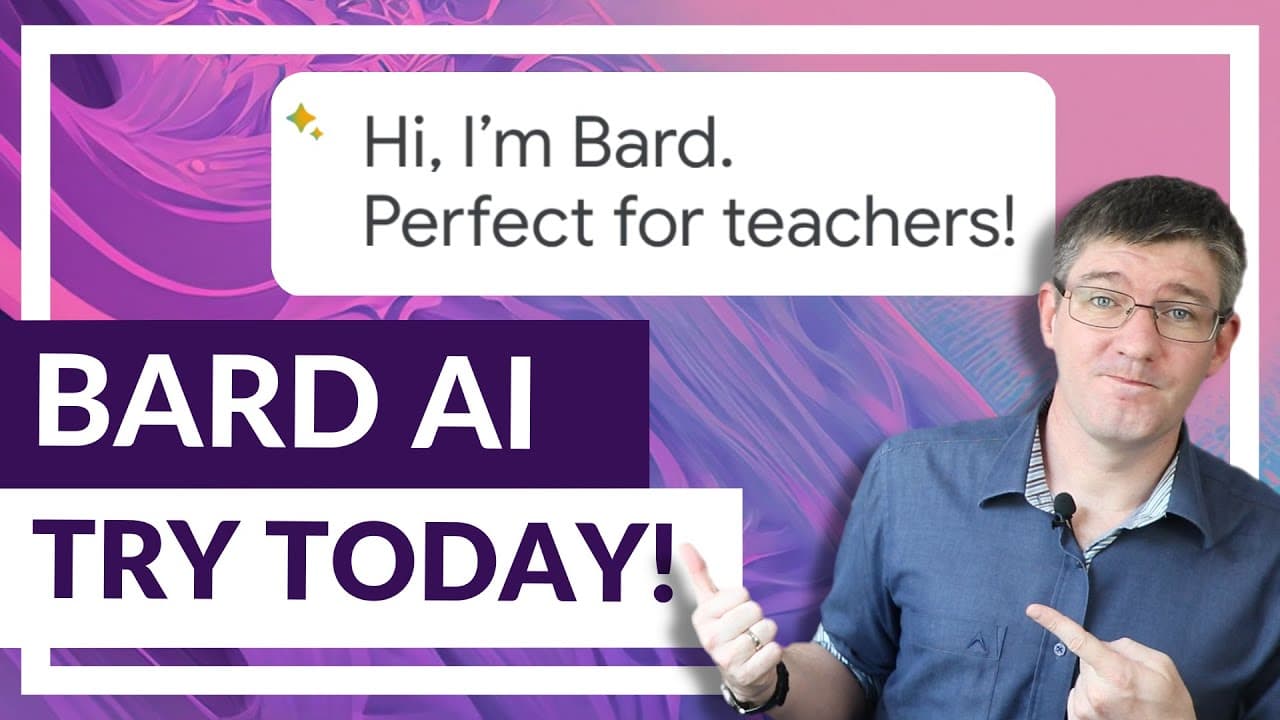
Google's Bard launched in February 2023, folded into Gemini a year later, and NotebookLM has gone through two renames of its own since—four names for roughly two product lines in about three years (Fitzpatrick, 2026; Fitzpatrick, D. (2026, July 16). NotebookLM is now Gemini Notebook. I'm confused. Forbes. https://www.forbes.com/sites/danfitzpatrick/2026/07/16/notebooklm-is-now-gemini-notebook-im-confused/View in referencesOpen source (opens in new tab)Martin & Johnson, 2023; Martin, R., & Johnson, S. (2023, July 12). Introducing NotebookLM. The Keyword. https://blog.google/technology/ai/notebooklm-google-ai/View in referencesOpen source (opens in new tab)Nieva, 2024; Nieva, R. (2024, February 8). Google has renamed Bard after Gemini, the AI model that powers it. Forbes. https://www.forbes.com/sites/richardnieva/2024/02/08/google-gemini-bard-advanced/View in referencesOpen source (opens in new tab)Pichai, 2023; Pichai, S. (2023, February 6). An important next step on our AI journey. The Keyword. https://blog.google/technology/ai/bard-google-ai-search-updates/View in referencesOpen source (opens in new tab)Zapfel, 2026)Zapfel, R. (2026, April 8). Try notebooks in Gemini to easily keep track of projects. The Keyword. https://blog.google/innovation-and-ai/products/gemini-app/notebooks-gemini-notebooklm/View in referencesOpen source (opens in new tab). Anyone who designed a PD session around "Bard 101" handed their learners a workshop that was outdated before the training cycle even finished. The competency worth naming is the underlying capability—for instance, a walled-garden tool that answers only from what you give it and shows where each answer came from. The technical term for this type of function is retrieval-augmented generation, or RAG (Lewis et al., 2020)Lewis, P., Perez, E., Piktus, A., Petroni, F., Karpukhin, V., Goyal, N., Küttler, H., Lewis, M., Yih, W., Rocktäschel, T., Riedel, S., & Kiela, D. (2020). Retrieval-augmented generation for knowledge-intensive NLP tasks. Advances in Neural Information Processing Systems, 33. https://ai.meta.com/research/publications/retrieval-augmented-generation-for-knowledge-intensive-nlp-tasks/View in referencesOpen source (opens in new tab)—not whatever the app happens to be called this month.
Why "just adapt the K–12 version" doesn't quite work
The tempting move is to tell adult educators to borrow what applies from the K–12 material. Some of it transfers. But a framework built around children carries assumptions that don't fit adults: safeguards designed for still-developing judgment, parental rights, and age-appropriate limits on autonomy. An adult learner drafting a resume, preparing for a citizenship interview, or messaging a child's teacher is in a different situation entirely—legally, cognitively, and in terms of what they want AI to do for them.
Adult education already has its own theory of learning—andragogy (Knowles, 1980)Knowles, M. S. (1980). The modern practice of adult education: From pedagogy to andragogy. Follet.View in references. A discipline with its own theory deserves its own frameworks, not borrowed ones. When the field keeps adapting frameworks built for other audiences, it ends up an afterthought rather than a starting point. That's an old pattern in adult education, and AI is only the most recent place it appears.
Not starting from scratch
A framework built specifically for adult educators, on andragogy's own terms, already exists. UNESCO's Institute for Lifelong Learning launched the DELTA Framework—Digital Empowerment for Lifelong Learning and Transformative Andragogy—in late 2025, with a companion course built for the AI era (UNESCO Institute for Lifelong Learning, 2025)UNESCO Institute for Lifelong Learning. (2025). Digital empowerment for lifelong learning and transformative andragogy (DELTA) for adult educators. https://unesdoc.unesco.org/ark:/48223/pf0000396041View in referencesOpen source (opens in new tab). It hasn't shown up in any of the U.S. guidance I've read, and nothing on record suggests it's been adopted here yet. That seems like a missed connection more than a dead end.
The field also has a domestic precedent, specifically the same adult education competencies mentioned earlier. Back in 2015, the Office of Career, Technical, and Adult Education (OCTAE) at the U.S. Department of Education published the Adult Education Teacher Competencies: four domains, seventeen competencies, a self-assessment, validated with roughly 2,000 practitioners (American Institutes for Research, 2015)American Institutes for Research. (2015). Adult education teacher competencies. U.S. Department of Education, Office of Career, Technical, and Adult Education. https://lincs.ed.gov/federal-initiatives/teacher-effectiveness/competenciesView in referencesOpen source (opens in new tab). It predates the emergence of generative AI and therefore does not address it. Still, the point holds: this kind of framework has been built for adult educators before, and a state guidance document already sends educators to it. One option might be to extend existing ED-endorsed competencies rather than create a separate, standalone set. However, adult education's federal home may be shifting toward the Department of Labor, and its future stewardship and direction remain uncertain. Another might be to build a complementary set of competencies directly aligned with the new DOL guidance. Or perhaps this work is better handled at the state, consortia, or LEA level.
A sketch, not a blueprint
I don't have a full framework prepared to share, nor am I planning to build the entire system alone. This is a conceptual outline indicating a possible direction, not a comprehensive project plan. What I can provide is an example illustrating a potential pathway. Let's explore the DOL-alignment option mentioned above.
Walk this way
BRIDGES crosswalks its own digital skills with external frameworks such as Northstar Digital Literacy, ISTE, and DigComp, so a program using one of these can locate the corresponding BRIDGES skill (World Education, 2025, p. 15)World Education. (2025). BRIDGES: An open skills toolkit and framework for building digital resilience. https://digitalskillslibrary.org/bridges-interactive/View in referencesOpen source (opens in new tab). An AI-readiness framework for adult educators could do something similar with the DOL AI Literacy Framework—though the crosswalk would run in a different direction, translating DOL's worker-facing content areas into what an educator needs to know and be able to do to teach toward them.
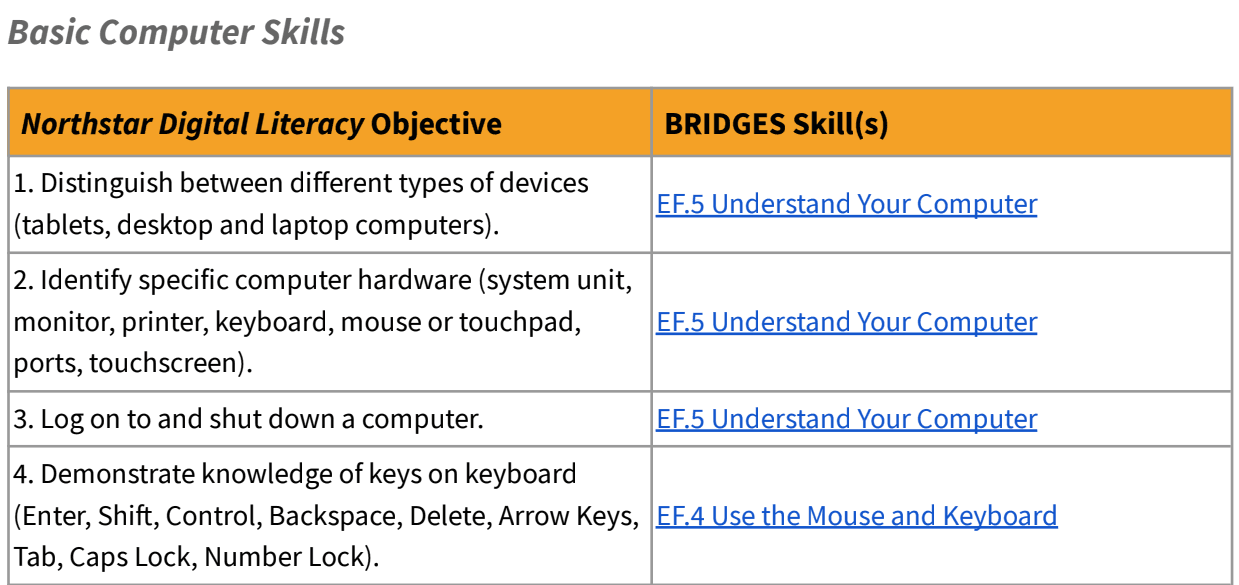
As you can see in the example above, Northstar Digital Literacy Objectives 1, 2, and 3 crosswalk to BRIDGES Skill EF.5 Understand Your Computer. If we follow that link, we would see EF.5 in detail, including the code, skill definition, and "I can" statements.
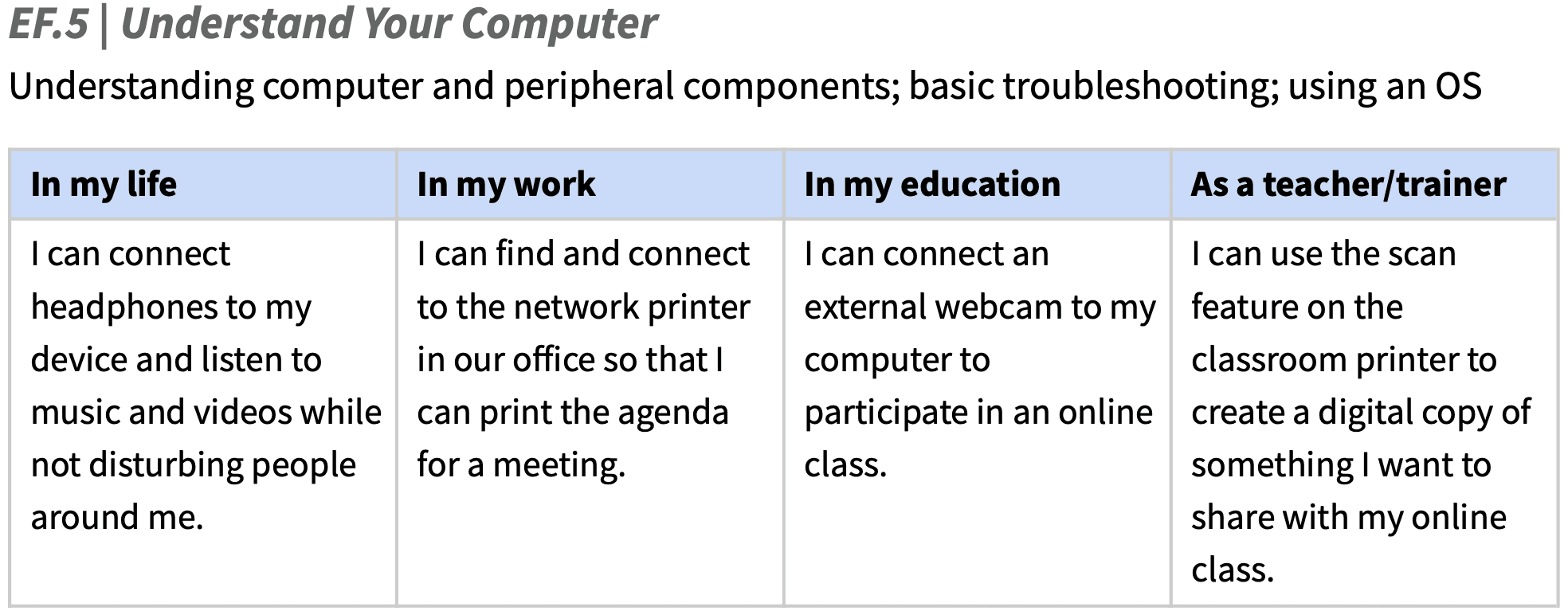
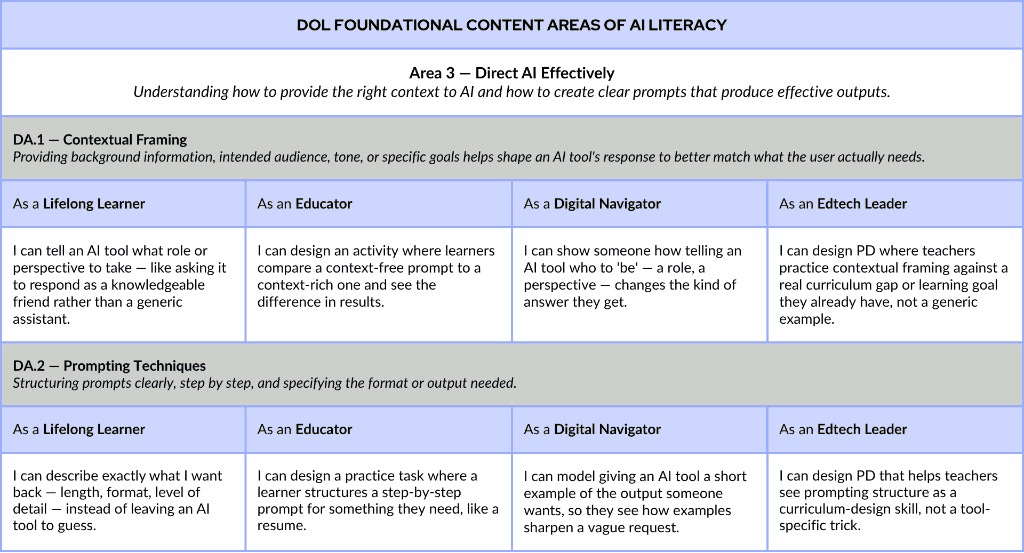
Here's what that translation could look like for one of DOL's five content areas—Direct AI Effectively—broken into two of its content sub-areas and worked through across four roles relevant to adult ed:
A fork in the road
In this example, I borrowed BRIDGES' format—not by expanding on it, but by remixing its coded-skills and plain-language "I can..." structure into a distinct framework tailored for adult education. That's one way this could take shape, not a claim that it's the direction I'd recommend over the others mentioned above. I chose it because BRIDGES is openly licensed (CC BY-NC-SA), which means the format is open to adaptation rather than just referencing. I believe that licensing should remain a flexible component in any adult education readiness project, allowing the field to modify as needed. (Worth saying directly: that's a comment on the license, not necessarily an endorsement of World Education or BRIDGES as the definitive answer here.)
For your consideration
The open question isn't whether any framework for teaching AI literacy to adults exists. It's about whether the field—or whoever ends up stewarding adult education—will build, adopt, or adapt one designed to prepare adult educators, rather than leaving them to either reverse-engineer it from documents written for a different audience or build it from scratch.
A quick note before I finish: this isn't a formal research study or a comprehensive review of the field. It's simply a snapshot of how things appear from my perspective at this moment. However, I believe there's significant value in considering this area seriously for future research.
If you know of any work already underway on this, I'd like to hear about it. I'd be glad to learn that more is happening than I've seen so far.
In progress,-Jerry
Related reading
- What is Retrieval-Augmented Generation (RAG)? (opens in new tab)
cloud.google.com
- TPACK in the age of ChatGPT and Generative AI (opens in new tab)
tandfonline.com
- The Difference Between Emergency Remote Teaching and Online Learning (opens in new tab)
er.educause.edu
- Goals Before Tools: Reimagining and Rebuilding adultedtech.com (opens in new tab)
adultedtech.com
Comments
Sign in with GitHub to join the discussion. Each Lab post uses its own thread (linked by page URL).